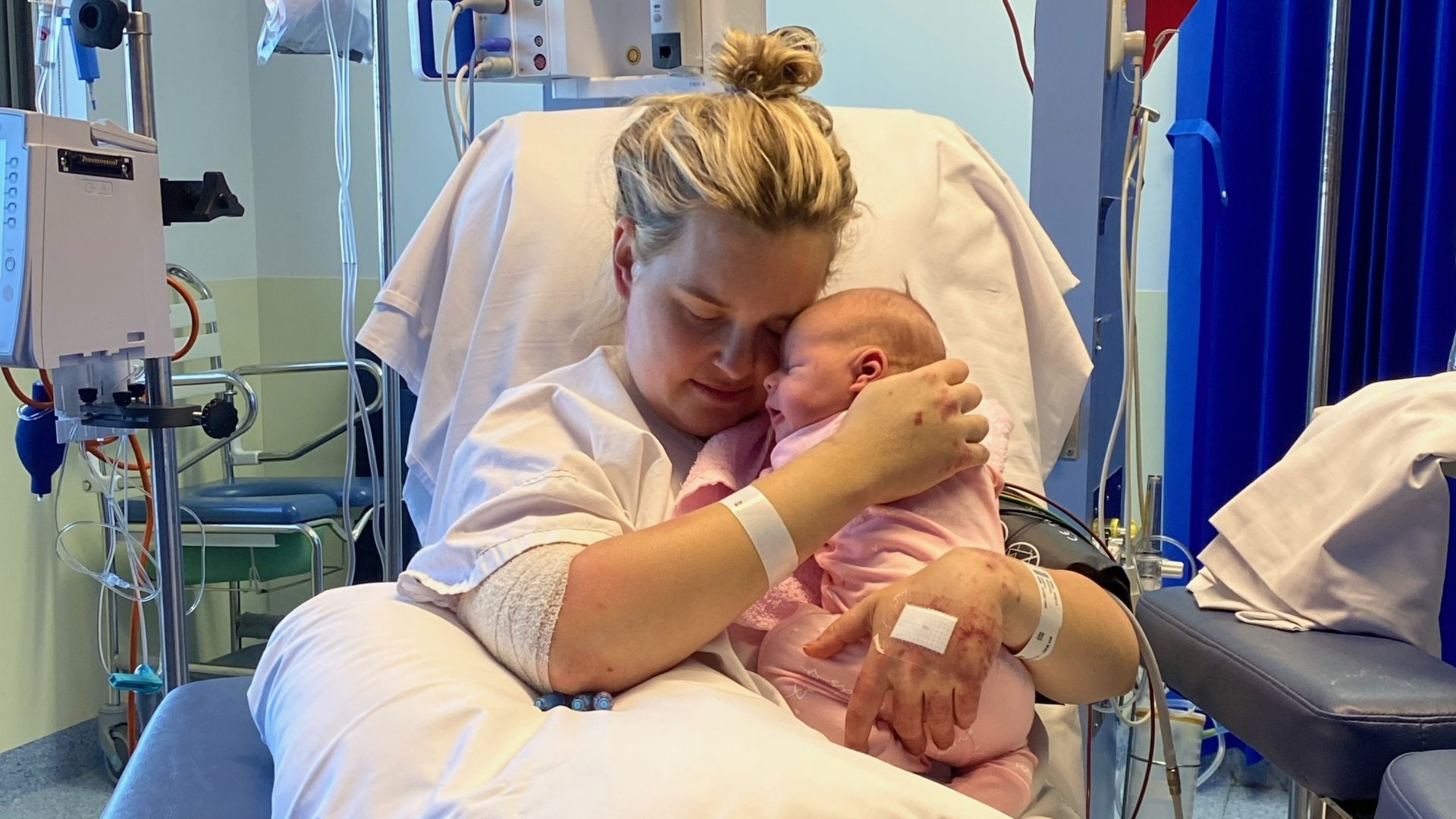
Emma’s pregnancy was considered low risk. She, her husband, Andrew and their 3‑year‑old daughter, Mia were eagerly awaiting the arrival of baby Pippa. At just 29-years-old, Emma was healthy, active, and excited to embrace life as a mum of two.
But within hours of giving birth, everything changed…
“I was fine that morning – I had a shower, spoke to my family, I felt completely normal,” said Emma. ”But… by the afternoon… everything changed.”
While giving birth, Emma began to bleed heavily which signalled to doctors that something was not right. Before the situation escalated, nurses captured an emotional video of Emma, Mia, and newborn Pippa. A video, Emma still finds hard to watch because of what unfolded so quickly after that.
Emma’s platelets had plummeted. She was rushed from the maternity ward at Monash Health – Dandenong Hospital for urgent tests, including a bone marrow biopsy. Doctors discovered she had developed a rare and aggressive form of leukaemia.
Almost immediately, she developed Disseminated Intravascular Coagulation (DIC) — a dangerous condition that causes both severe bleeding and clotting, attacking the organs. Her kidneys began to fail.
Emma was transferred to Monash Medical Centre Clayton and taken straight to the Intensive Care Unit (ICU).
“It all happened so quickly,” said Emma. “Things from that point on were a bit of a blur. But the doctors at Monash Health saved my life.”
“ICU was terrifying. I didn’t know what was real”
Emma spent close to two weeks in ICU. Much of that time she drifted in and out of consciousness, but the memories that remain are vivid — and profoundly traumatic.
While being treated for her leukemia and DIC, Emma remembers the persistent, loud noise that felt like it was coming from behind her and the suffocating feeling of being in a room that made her feel closed in.
“I would fall asleep and wake up in a panic,” said Emma. “I had horrible nightmares. I dreamt my girls were trapped in a car. I dreamt I was stuck in a restaurant and couldn’t get out. I saw aliens around my bed.”
These hallucinations were part of intense delirium, a frightening condition common in ICU. Delirium is a temporary but severe feeling of confusion that happens when someone is very unwell. It can make the world feel unreal and people may see or believe things that aren’t actually happening.
“I would hear nurses talking to someone else and think they were talking to me. My sister, Sarah, said I was answering questions no one had asked. I didn’t know what was real. I didn’t know where I was. I didn’t know what time it was” said Emma. “Even small objects became terrifying.”
“My family had put a salt lamp in the room to try and calm me, and I thought it was on fire”.
“The room changed everything…”
Once Emma’s condition stabilised, she was moved from ICU to a general ward. Emma was even given a day pass to spend Christmas Day with her girls and her family. But that possibility was short-lived as she quickly became unwell again and was rushed back to ICU with sepsis – on Boxing Day.
“When they took me to ICU the second time, they put me in a room that sounded like it had an engine was running in it. I told my family that I couldn’t be in that room. I felt trapped. It made everything worse.”
Staff quickly moved Emma to another room – one that was quieter, larger, calmer, and had glass doors so she could see the nurses outside.
“It made such a difference. I could see out. I could see people. It felt calmer. I set up my photos, my lamp, my things. It became my space. It felt like my room.”
Most importantly, Emma’s family could stay with her for longer.
“They would sit with me at night, calm me down, tuck me in with my blanket, make sure I had everything I needed. Those moments were everything. Being away from my girls broke me… those small moments helped me get through it.”
“Even a short stay in ICU can cause trauma. I had more than one.”
Emma experienced more than one ICU admission within a few months, alongside dialysis sessions three times a week, complications, sepsis and profound separation from her children.
There were moments Emma still cannot fully explain — waking up and believing her family had come to say goodbye, thinking she was dying, feeling terrified to fall asleep.
“What I went through… it stays with you. I didn’t realise how much the environment affects your mind. The noise, the lighting, the shadows, the not knowing the time. It all played into the delirium.”
“If we can create calmer ICUs for people… why wouldn’t we?”
Emma is now in remission from leukaemia and awaiting a kidney transplant. She continues to attend dialysis and work through the psychological aftermath of her ICU stays.
“If creating quieter, calmer ICU rooms means people don’t have to go through the trauma I did… then it’s undeniably the right thing to do. No one should wake up afraid, confused or traumatised. A better environment would have made such a difference.”
Her message to supporters is simple:
“You don’t realise how much the room matters until you’re living in it. If we can make ICU calmer, safer and less traumatic… it will change people’s lives.”
We’re redesigning an ICU of the Future to help patients like Emma and we need your help.
Your support can help us build an ICU of the Future…
Where body and mind can heal.
With the upcoming expansion of the Monash Medical Centre Tower and new Intensive Care Unit, we have an opportunity to include new state-of-the-art technology to reimagine care and the experience for our patients and their families.
With your support, we can enhance the features in up to 10 of our new ICU rooms, so patients not only survive with lifesaving care, but thrive.
All funds raised will support new technology to build a calm environment with room features such as circadian lighting, noise-reducing systems and patient wellbeing at the centre of their design.
With 1 in 2 of us needing ICU care, this is a gift, large or small, that will make the world of difference for critically ill patients in our local community.
You can help build the future of healthcare.